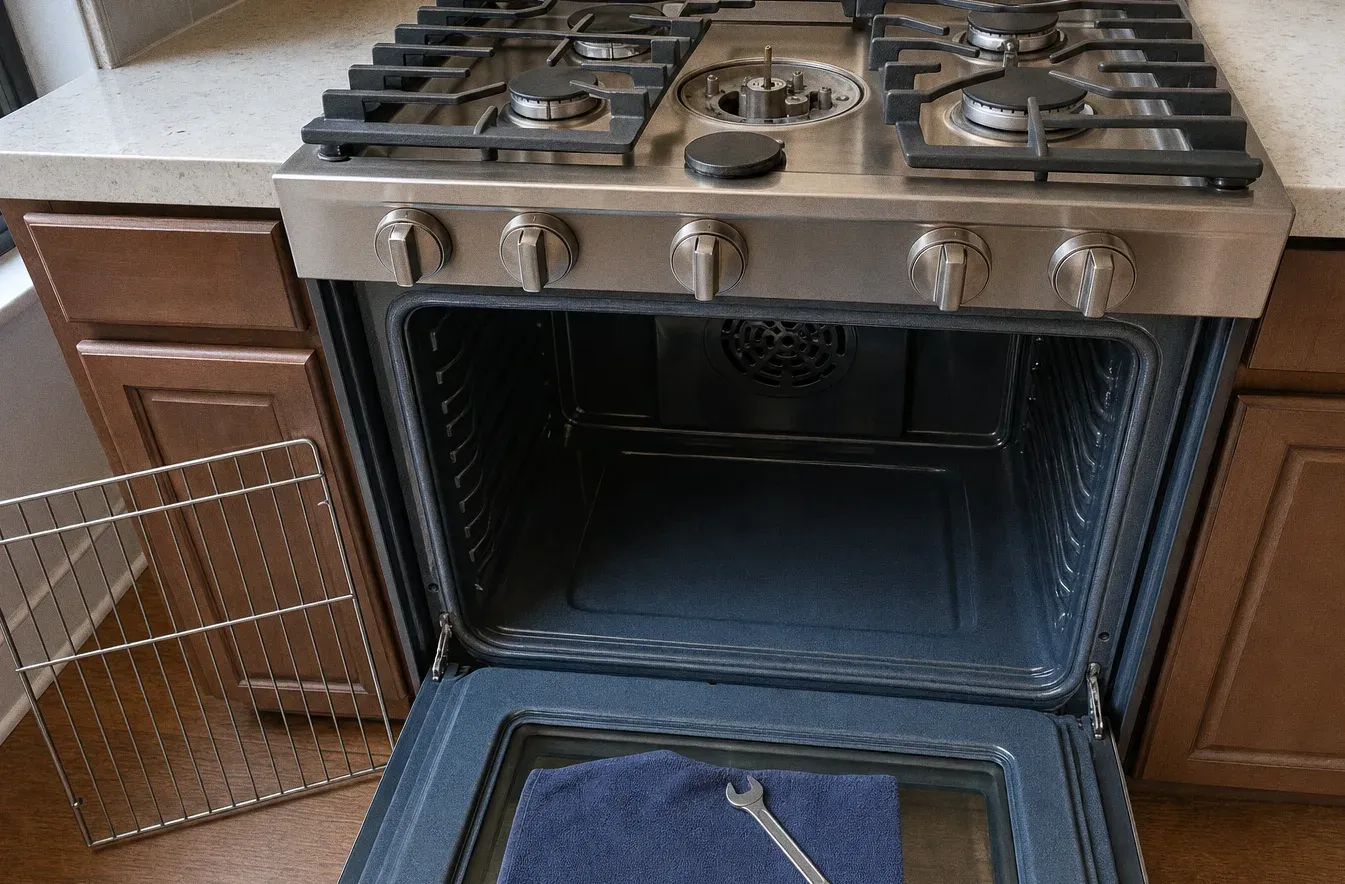
A Wolf Burner in Boston That Clicks Forever — Reading the Symptom
A burner that clicks and then catches with a thump has been letting gas gather before it lights, which makes a delay more urgent than a burner that never lights at all. Cap seating, glazed ports and a damp or cracked electrode account for most of them.
Say this part first. A gas smell that hangs about instead of clearing ends the investigation before it starts. Leave the building and call the gas utility from outside — not a repair firm, not us. Everything below is written for a range that clicks, or that lights eventually, in a kitchen where nothing smells wrong.
With that settled: the burner that takes its time is the one worth paying attention to. A burner that never lights is an inconvenience with an obvious symptom. A burner that clicks for a while and then catches with a soft thump has been quietly letting gas collect around the cap before something finally set it off, and that thump is the sound of a small volume igniting all at once. It is easy to live with, because it does work in the end. It is the version we would rather see sooner.
The clicking itself is often misread. It confirms the spark module is doing its job and firing. It says nothing whatever about whether gas is arriving where it needs to be, which is why “it’s still clicking, so the igniter is fine” is only half a sentence.
One burner, or all of them? Answer that first
Turn each burner on in turn and note which ones misbehave. One burner alone points at that burner’s own hardware — its cap, its ports, its electrode. When every burner misbehaves at once, the cause is something they all share — the spark module, the gas supply, or the earth path the system depends on. That single question halves the problem before any tools come out.
It also settles a distraction. On many ranges the burners share one module, so turning a single knob sets every electrode on the top clicking at once. That is normal and not a fault, however alarming it sounds in a small Back Bay galley where the sound has nowhere to go.
Put clicking that carries on with all the knobs turned off into a category of its own; it is a different animal altogether. Nothing should be sparking when nothing has been asked for.
Before touching anything, write down which burners, what changed recently, and whether the range was cleaned in the last few days. That last one solves a surprising share of these on its own.
The mechanical checks, which are most of the answer
Most delayed and failed ignitions come down to a cap that is not sitting where it should be. The cap has one correct position. If it sits a fraction proud, tilted, or rotated off its locating features, the gas leaving the ports no longer arrives at the spark in the pattern the burner was designed around, and a healthy spark can sit there doing nothing useful.
Check it cold. With the cap lifted clear, inspect the seat underneath, then let the cap back down again without forcing anything. It should settle flat into place, and pressing an edge should not make it rock. If it rocks, it is not seated, and no amount of clicking will fix that.
Ports next. A boil-over leaves sugar and starch in the slots around the rim and they carbonise into a hard glaze. Warm water, a soft brush and patience clear that. Do not open a port up with anything stiff and metal; the size and shape of those slots is what makes the flame behave, and enlarging one is permanent.
Then moisture, which is the reason so many of these start immediately after a cleaning session. Water sitting across the electrode or pooled under the cap suppresses ignition until it has completely gone, and completely gone takes longer than a wipe with a towel. Leave the parts off and let the air get to them rather than reassembling a damp burner and concluding the range has failed.
Reading the spark you can see
Turn the kitchen lights down and watch. A healthy spark is a tight, bright, regular snap that jumps a short distance from the electrode tip to the nearest metal on the burner, in time with the clicking. It should look purposeful and it should go to the same place every time.
Two things spoil that. The first is a cracked ceramic insulator around the electrode. Once cracked, the spark finds a shorter path through the fault and jumps somewhere convenient instead of across the intended gap — often down into the burner base, sometimes with a visible flash in the wrong place. The clicking sounds completely normal, because the module is still firing on schedule.
The second is residue bridging the gap. Grease, boil-over and cleaning film all conduct better than air when they are damp, and the spark takes the easy route through the film instead of across the space where the gas is.
Both explain the thing that confuses people most: the range is making all the right noises and none of them are landing anywhere useful. Sound is not evidence of a spark in the correct place. Only looking is.
A delay is a fault report
When a burner lights late, the gas valve has been open for those seconds and gas has been accumulating around the burner while the spark failed to catch it. When it finally does, the small volume that gathered goes up at once — the thump, and occasionally a brief flare that lifts past the edge of the pan.
That is why we treat a delay as more urgent than a burner that does not light at all. A dead burner tells you plainly that something is wrong and you stop using it. A slow one keeps working, so it stays in service for months, and the accumulation happens every time somebody makes coffee. In the garden-level kitchens under Beacon Hill row houses, where the ceiling is low and the room is small, that is not a fault to leave alone.
The checks above all apply — cap seating, ports, a clean dry electrode, a spark that goes to the right place. What does not apply is any attempt to adjust the gas side. Valves, orifices and the air the burner draws are not homeowner territory, and a delay that persists after the mechanical checks have been done properly is the point to hand it over. Our Wolf Range Repair page sets out what that covers.
The symptoms that mean stop now
One line in this article outranks everything else in it, so here it is a second time: where a gas smell will not clear, you get out and you phone the utility from outside.
Short of that, three symptoms end the home stage. Delayed ignition that survives a proper clean and dry. Continuous sparking with everything switched off. And a burner that catches properly and then dies unprompted — a different fault again, and one that implicates the flame-sensing side rather than the ignition side.
What a technician can establish that you cannot: whether gas is arriving at the burner at the right pressure, whether the module is firing at the right energy, whether the switch behind a knob is opening when the knob says it should, and whether the earth the spark system depends on is intact. Washington Square, Beacon Hill and Jamaica Plain are all within our patch. At the top of the page sit a phone number and a booking link; either one starts this off.
Asked on the phone
It started right after I cleaned the range. Why?
Two reasons, and both are ordinary. Water sitting on the electrode or trapped under the cap suppresses ignition until it is completely gone, and completely gone takes longer than a towel suggests. The other is reassembly: a cap that goes back slightly proud or rotated off its seat sends gas somewhere the spark is not. Take the parts off, dry them in open air, and reseat carefully.
The burner keeps clicking even with every knob off.
That is a fault of its own and worth acting on rather than ignoring. Sparking with nothing requested usually means a switch behind a knob has stopped opening, or moisture has found its way behind the control panel and is keeping the circuit made. A spark firing continuously beside a gas burner is not something to live with, so cut power at the breaker and arrange a visit.
Can I clean the ports with a pin or a paperclip?
No. Those slots are dimensioned to shape the flame, and anything rigid pushed through one widens or deforms it permanently, which changes how that burner behaves for good. Soak the cap, use warm water and a soft brush, and give the deposits time to soften. If a port will not clear that way, it needs looking at rather than forcing.